African wild dog communication is more than a collection of unusual noises. Painted dogs use calls to find one another, close-contact greetings to reinforce social bonds, and body signals during group interactions. In Botswana, researchers also found that sneeze-like sounds during rallies were linked to whether a pack got up and moved together.
The often-repeated line that wild dogs “vote before every hunt” goes further than the evidence. The study examined departure after social rallies, and it did not establish that every sneeze is a deliberate ballot. To understand the pack’s social structure beyond its signals, read our African wild dog pack guide.
How do African wild dogs communicate?
They communicate through sound, posture, touch and scent. The signal’s meaning depends on what the dogs are doing: a separated animal needs to regain contact, while a resting pack may gather in an energetic greeting before moving off. A sound heard during one of these events should not automatically be assigned the same meaning in every setting.
| Signal | Common setting | What it helps the pack do |
|---|---|---|
| Hoo call | Dogs separated by distance or vegetation | Regain contact |
| Twitters, whines and squeals | Close-range greetings and other interactions | Maintain social contact |
| Posture, ear position and touch | Face-to-face meetings | Convey intent within the group |
| Sneeze-like nasal exhalations | Some pre-departure rallies | Contribute to a departure-related quorum |
| Scent cues | Encounters and marking | Carry information beyond immediate visual contact |
The African Wild Dog Conservancy’s field account describes a particularly varied vocal repertoire. Some calls happen at close range during greetings; others carry between pack members who have lost sight of one another.
What sounds do African wild dogs make?
Painted dogs do not rely on a single signature call. Their vocal repertoire includes hoo calls, twitters, whines, yelps and other sounds, many of which occur during social encounters. A useful way to understand the calls is to look at the situation in which each one is heard.
Hoo calls help separated dogs find the pack
A hoo is a repeated contact call used when pack members are apart. Dogs can separate while traveling through thick bush or after pursuing prey in different directions. The call helps them reconnect without needing to see one another.
The African Wild Dog Conservancy describes hoos as lower-pitched calls that dogs may make while moving. This is a contact signal, not proof that the pack has started a coordinated hunt. For how pursuit itself works, see our hunting guide.
Twitters, whines and squeals accompany greetings
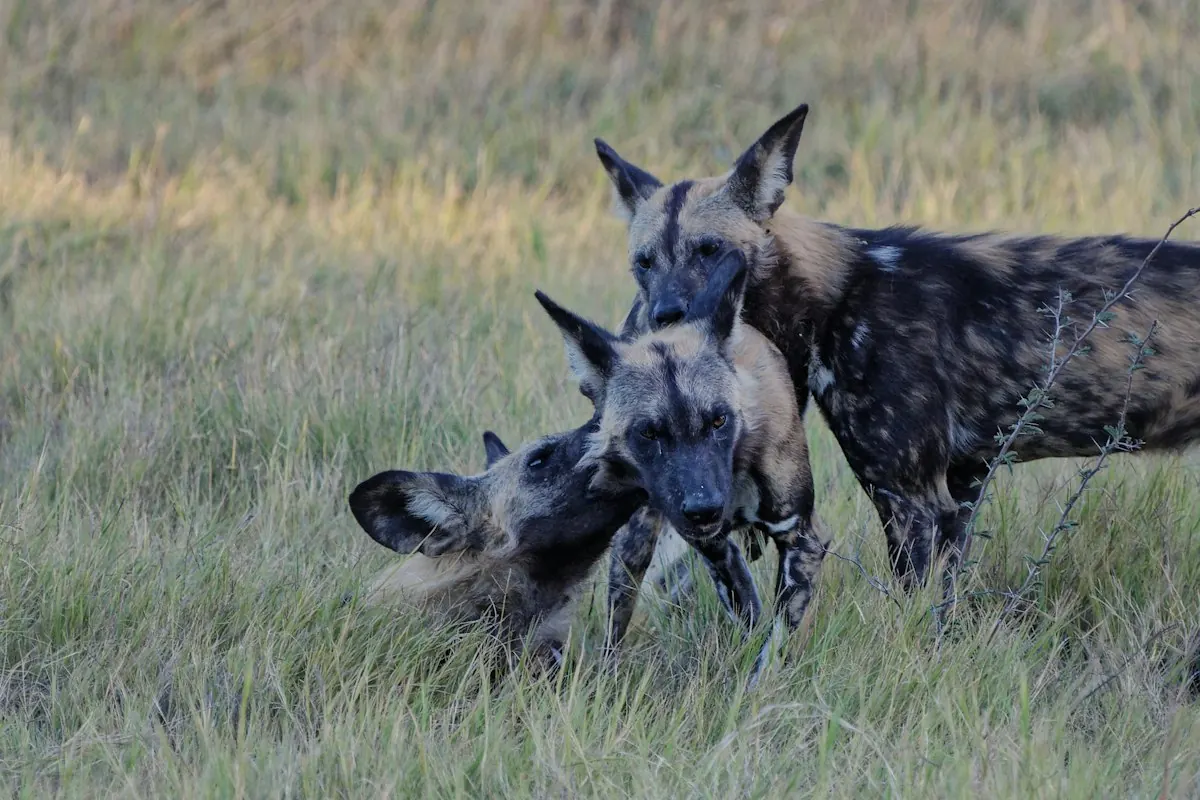
Close-up pack interactions can sound surprisingly birdlike. During an excited greeting, dogs may whine or squeal while other members join in with high-pitched twitters. These sounds occur alongside movement and physical contact, so listening to the audio alone can miss part of the exchange.
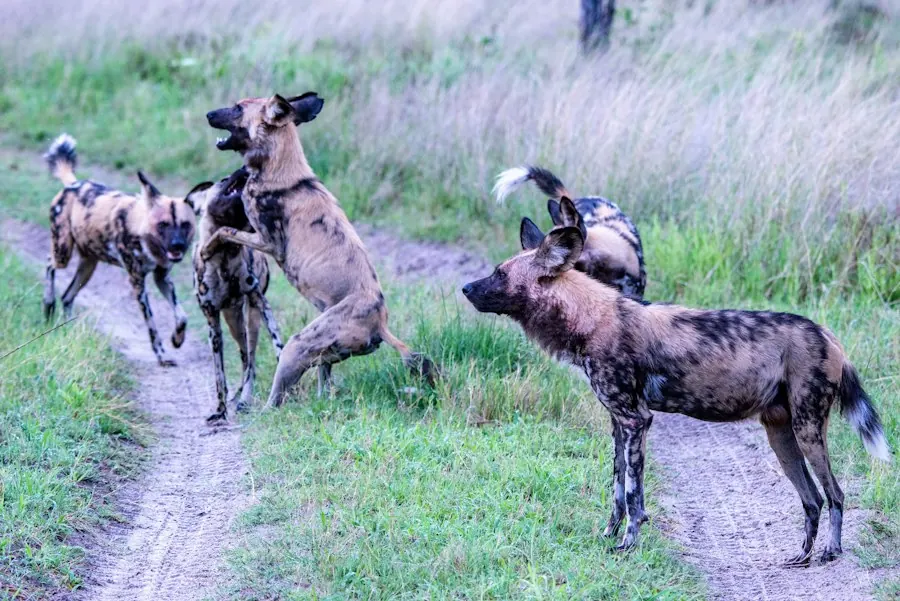
A dog may run toward another with its mouth open and ears folded back before more of the pack joins the greeting. The Conservancy describes such ceremonies before group movement. The sounds help illustrate why communication within a pack cannot be reduced to a simple list of calls.
Do African wild dogs bark or howl?
They are better known for twitters, whines and hoo contact calls than for the familiar bark of a pet dog or the long howl of a wolf. Some educational fact sheets simplify this to “painted dogs don’t bark,” but a strict never-bark rule is too strong for a varied canid vocal repertoire. The more useful distinction is which calls field observers commonly document and when they occur.
What does African wild dog body language mean?
Watch the entire interaction rather than treating one tail or ear position as a word with a fixed translation. Dogs change posture, approach one another, touch faces and vocalize as a group. Those signals together give more context than any single movement.
Greeting rallies combine movement, sound and touch
A rally is a lively gathering that can happen after a rest period and before the pack moves. One animal may initiate an encounter, and other dogs may join through close greetings and calls. Some rallies end with the pack leaving; others do not.
These gatherings are important to communication because they give pack members a chance to respond to one another. They also provided the setting for the sneeze study discussed below. A rally is not itself a step-by-step hunting tactic.
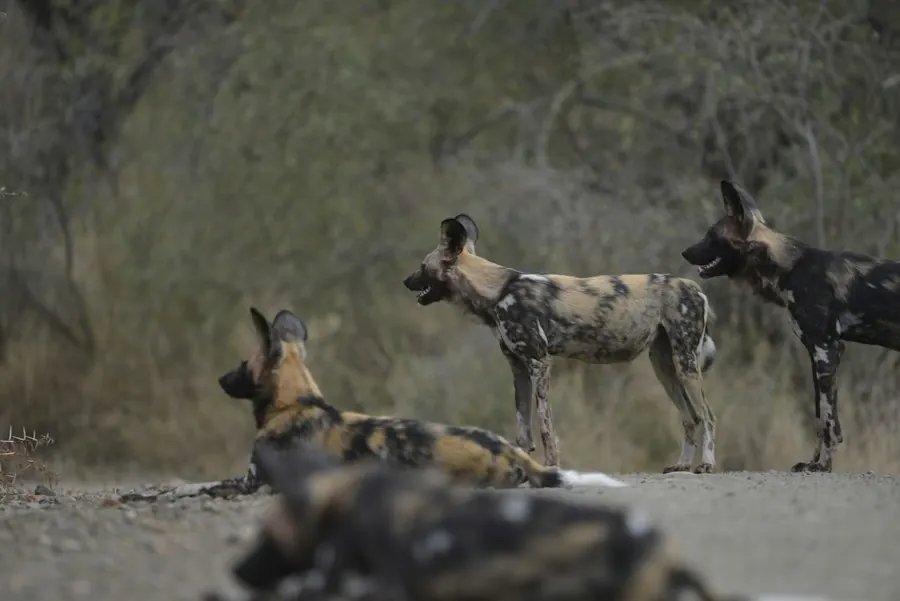
Ears and tails add visual context
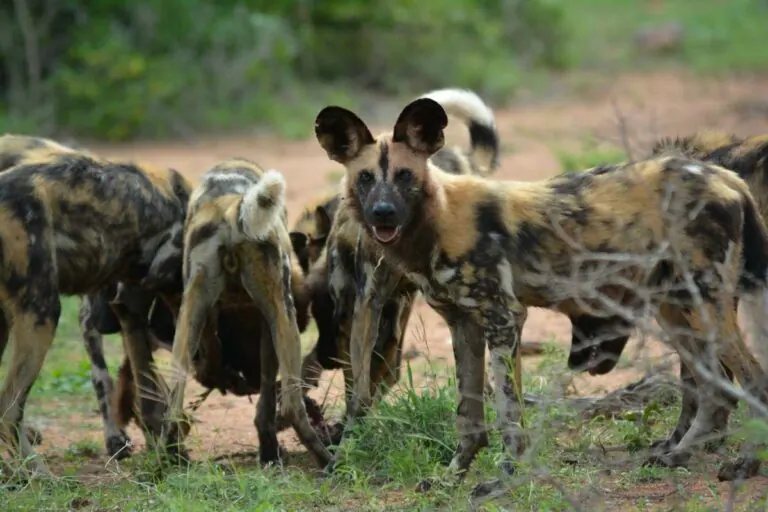
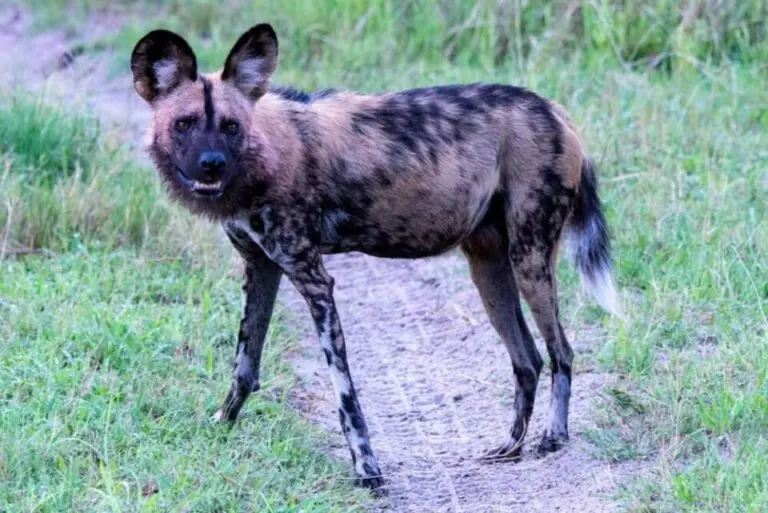
Ear position and body posture are part of face-to-face signaling. A visible white tail tip may also make a moving dog easier for others to keep track of in vegetation. That does not mean every ear tilt or tail movement has a scientifically established, one-to-one message.
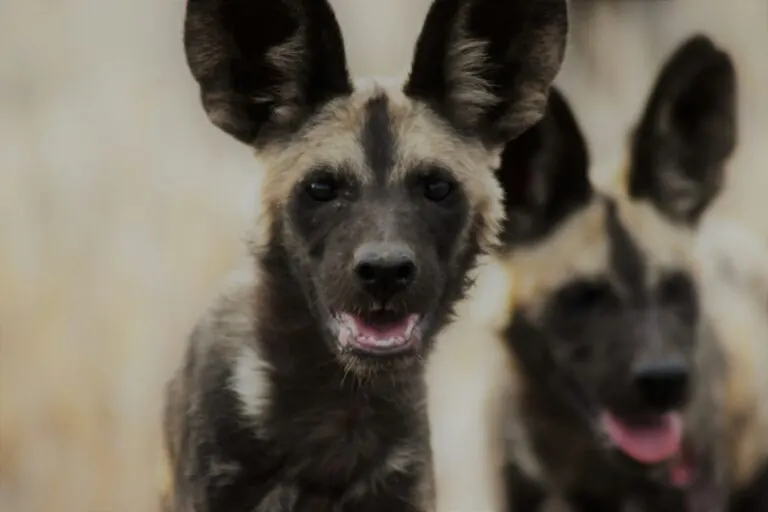
The safest caption for a still photo describes what is visible. It should not claim that a pictured dog is “voting,” warning the pack or submitting unless the behavior and context are documented. That distinction matters especially when an image is used to illustrate research it does not directly depict.
Why do African wild dogs sneeze before moving?
In a 2017 study published in Proceedings of the Royal Society B, researchers recorded 68 rallies from five free-ranging packs in Botswana. Rallies with more audible, rapid nasal exhalations were more likely to end in group departure. The researchers described a variable quorum: a minimum level of signaling associated with the pack moving off.
The dominant pair changes the threshold
When a dominant dog initiated a rally, fewer sneezes were associated with departure. When dominants were not involved, more sneezes were needed for a successful rally. Dominant participation influenced the threshold, but it was not a requirement for the pack to leave.
The Royal Society’s explanation of the study describes roughly ten sneezes when the dominant pair was not engaged. That is an observation from the studied packs, not a universal number every wild dog pack must reach. It also does not show that a single sneeze always equals one intentional vote.
Is “sneeze voting” a literal democracy?
“Voting” is a memorable shorthand for the study’s quorum result. It does not mean researchers proved the dogs consciously count ballots or that every pack member has equal influence. A careful description is that sneezes during some rallies predict whether the group departs, with the threshold varying by social context.
This distinction is easy to miss in short videos and fact lists. It makes the real finding more interesting: group movement can reflect contributions from several individuals without requiring the dominant pair to make every decision alone.
Do African wild dogs use scent to communicate?
Scent provides information that remains after a dog has moved away. Marking and sniffing can therefore add another layer to interactions beyond visible posture and sound. The precise meaning of any single mark depends on context, so a mark should not automatically be labeled a territorial boundary.
African wild dog packs range widely, and descriptions of their marking behavior differ between sources. Our planned guide to territory and range will handle home-range size and boundary questions. Here the key point is that communication is not limited to what humans can hear.
How communication helps the pack stay together
The same pack can be spread out in vegetation one moment and clustered together the next. Hoo calls help separated animals reconnect, while close-range sounds and greetings support contact once they meet. During some rallies, sneeze-like signals are associated with the decision to move as a group.
That is a practical communication system for an animal whose survival depends on companions. It does not require us to claim that the dogs plan every chase through conversation. Our pack structure article explains how those companions live and raise young together.
African wild dog communication FAQs
How do African wild dogs communicate with each other?
They use a mix of vocal calls, body posture, touch and scent. Hoo calls help separated members regain contact, while excited greetings involve high-pitched sounds and close interaction.
Why do African wild dogs sneeze?
Researchers observed sneeze-like nasal sounds during pre-departure rallies in Botswana. More sneezes were associated with a higher chance of the pack leaving, although that does not establish that every sneeze is a conscious vote.
What is an African wild dog hoo call?
It is a contact call associated with pack members finding one another after separation. Unlike a close-range greeting twitter, a hoo helps maintain contact across distance or vegetation.
Can African wild dogs leave without the alpha pair starting a rally?
Yes. In the Botswana study, dominant involvement lowered the number of sneezes associated with departure, but it was not essential. The study does not justify saying the dominant pair has complete control over every group movement.
Is a rally the same as a hunt?
No. A rally is a social gathering that may precede group movement, often after rest. A hunt can follow, but the rally itself is an interaction among pack members rather than a complete hunting strategy.