African wild dog pups begin life in a sheltered den and depend on much more than their mother. A breeding female is pregnant for about 70 days, and a litter may contain many more pups than a wolf or domestic dog litter. Other pack members help guard and feed the young as they grow.
There is no single litter number that fits every population or every stage of development. Some sources count pups at birth, while others count the young that emerge from the den or survive to a later age. This guide separates those measures and follows the pups from breeding to life with the traveling pack.
How do African wild dogs breed?
Most established packs have a dominant breeding pair, with other adults helping to raise the pups. The breeding female usually produces the main litter. That arrangement concentrates food, guarding and care on young that many adults can support.
Do all females in a pack have pups?
No. The dominant female usually breeds, while other females more often act as helpers. But “only the alpha female ever breeds” is too absolute: subordinate females sometimes produce litters too.
Research on cooperative breeding in Zimbabwe documented packs with more than one breeding female. Such cases depend on the pack and should not be presented as the standard arrangement everywhere. For the wider social order, see our African wild dog pack structure guide.
When are African wild dog pups born?
The timing changes by region. In much of southern Africa, breeding is seasonal and tends to align with cooler conditions, while populations nearer the equator can breed less seasonally. A single continent-wide birth month would therefore mislead readers.
How long is an African wild dog pregnant?
Gestation is about 70 days, or roughly ten weeks. Published accounts use slightly different ranges around that figure. The important distinction is between the length of pregnancy and the much longer period during which pups rely on a den and pack helpers.
The Animal Diversity Web species account describes gestation as approximately ten weeks. A veterinary review reports about 69–71 days. Neither figure means every female gives birth on exactly the same day of pregnancy.
How many pups do African wild dogs have?
Litters are often described as averaging around eight to ten pups, but averages differ by population and counting method. Some accounts report unusually large litters of about 20 or 21 pups. That upper end is possible, not the size readers should expect every year.
| Measure | What it means | How to read it |
|---|---|---|
| Litter at birth | Pups delivered by the mother | Can be larger than the number later seen outside |
| Pups emerging from the den | Young observed after their earliest weeks | Early losses may already have occurred |
| Pups surviving later | Young still alive at a stated age | A survival outcome, not the birth litter size |
This distinction matters when two reliable sources seem to disagree. The African Wild Dog Conservancy gives an average of about eight, while the Brookfield Zoo account uses roughly ten to twelve for the litters it describes. State which population and stage a number represents before comparing it with another.
African wild dog puppy growth: from den to pack
Pups do not go from birth straight into a running hunting group. Their food, coat and ability to travel change across the first weeks and months. The ages below are approximate, because development and field observations vary.
| Stage | What changes |
|---|---|
| Birth and early weeks | Pups remain sheltered and depend on the mother for milk and warmth. |
| Around three to four weeks | Young pups may begin appearing outside the den and their distinctive coats develop. |
| Following weeks | Regurgitated meat becomes part of their diet as weaning progresses. |
| Around ten to twelve weeks | Many packs start traveling more widely with the growing pups. |
What are African wild dog pups like at birth?
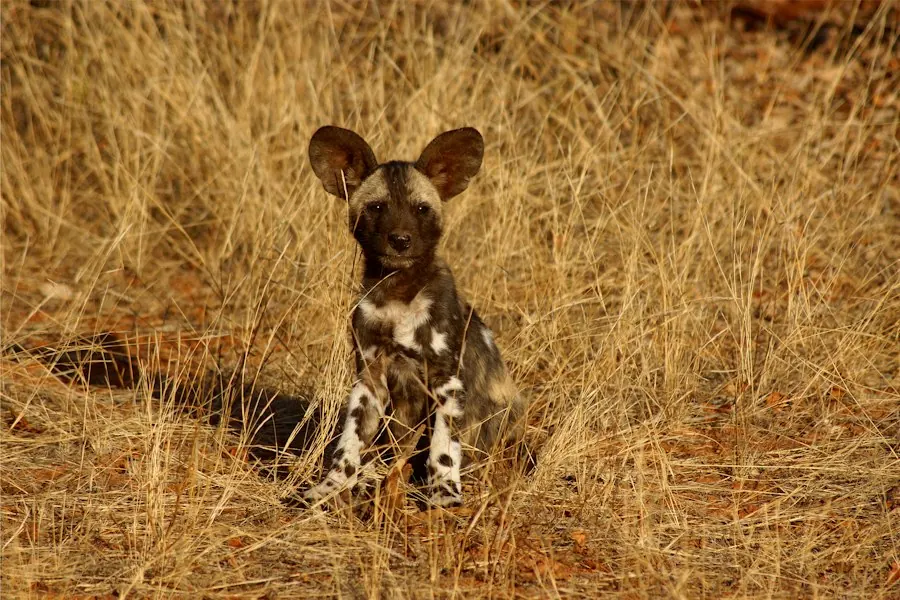
Newborn pups are small and vulnerable. They remain in the den while their mother stays close, and adults bring food to the nursing female. Their later patchwork markings are not fully apparent at birth.
As the pups grow, individual black, tan and white patterns become clearer. Those patterns eventually help observers distinguish one dog from another. The Brookfield Zoo’s pup-development story describes that coat change in a documented litter.
When do the pups first leave the den?
Pups may first appear outside after roughly three to four weeks, but that is not the same as abandoning the den. The site remains their center of care while adults hunt and bring food back. Later, once the pups can keep up better, the pack resumes wider travel.
Our planned denning article should explain burrow choice, den changes and den-site risks in detail. This page focuses on what the den period means for the pups. The African Wild Dog Conservancy describes packs moving on more regularly when pups are around ten to twelve weeks old.
How does the pack raise and feed the pups?
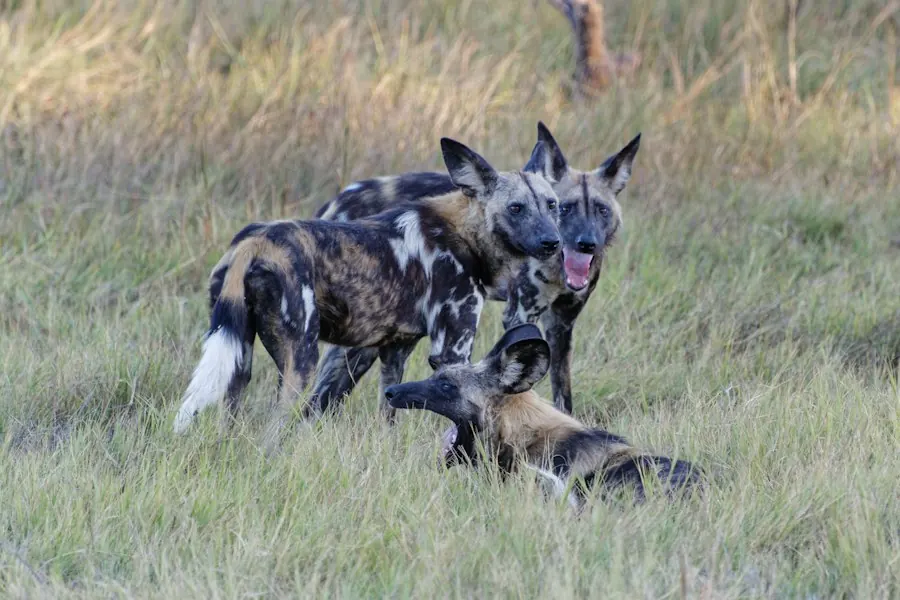
African wild dogs are cooperative breeders. While the mother nurses her young, other members hunt, bring food to the den and may remain nearby as babysitters. A pup therefore relies on a network of adults rather than a single provider.
What do African wild dog pups eat?
They begin with milk and later take regurgitated meat from adults returning after a hunt. The change toward solid food happens over weeks rather than on one exact date. Regurgitation allows a pup at the den to receive meat without following the hunters.
Once pups can feed at a carcass, adults often give them early access. This is one part of the pack’s broader food-sharing behavior, which our diet guide explains. It does not mean every pup gets enough food in every season.
What does a babysitter do?
An adult may stay near the young while others leave to hunt. This helps keep vulnerable pups attended and lets their mother recover or feed. The specific adult and its duties can change, so “babysitter” is a useful description rather than a permanent rank.
What affects African wild dog pup survival?
Food and the number of available helpers matter. A larger functioning pack may be better able to hunt, feed the mother and guard pups at the same time. That is one reason pup survival should not be inferred from the number born.
Researchers have examined how group size relates to pup production and survival, but a single survival percentage will not describe every region or year. Den threats and disease can also affect outcomes. The full ecology of where dens are placed belongs in our separate denning guide.
What happens as pups grow up?
Young dogs eventually travel with the pack and learn its routines. As they mature, some will leave in groups to seek unrelated mates and help form new packs. That later dispersal is a different life stage from the first weeks of pup care.
For the adult roles, breeding hierarchy and new-pack formation, read our pack structure article. Keeping those topics together there leaves this page focused on breeding and growing pups.
African wild dog pups FAQs
How many pups can an African wild dog have?
Litter size varies, with many sources describing averages around eight to ten pups and exceptional litters reaching about 20 or 21. The exceptional figure is a reported upper end, not a typical birth count. Always check whether a source counted births or pups surviving to a later stage.
How long is the gestation period?
About 70 days, or roughly ten weeks. Sources may give slightly different ranges around that approximation.
Do all dogs in the pack breed?
Usually the dominant pair produces the main litter, while other adults help care for it. Subordinate females can sometimes breed, so the arrangement is not an absolute rule.
When do African wild dog pups come out of the den?
They can first appear outside at roughly three to four weeks old. They still rely on the den for some time after that and generally begin traveling more widely with the pack later.
What do African wild dog pups eat?
They start on milk and gradually take regurgitated meat from adults. When they are old enough to eat at a kill, they often receive early access to the carcass.
Why do adult wild dogs help raise pups that are not their own?
Cooperative care supports the pack’s young and helps a family group function while some adults hunt. Not every helper is a pup’s parent, and the details of kinship and breeding vary between packs. Our pack article explains the family structure behind that cooperation.