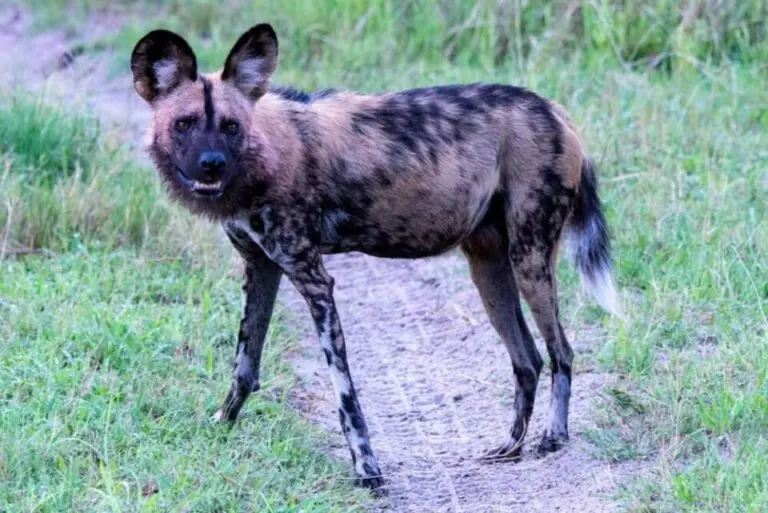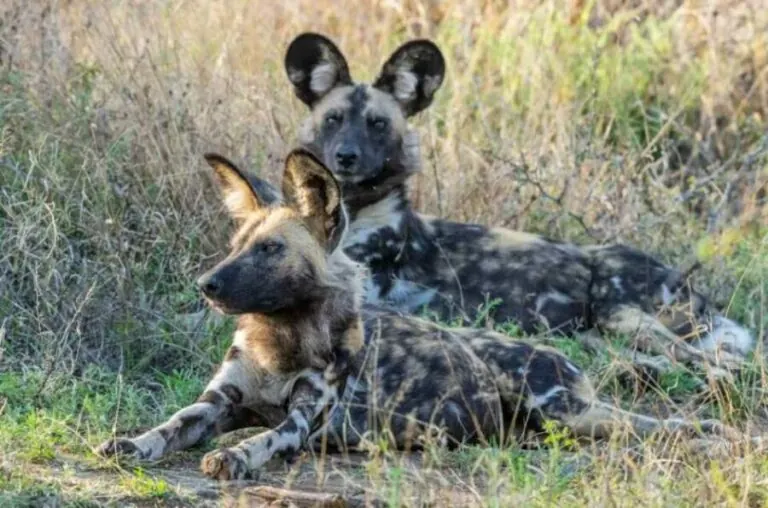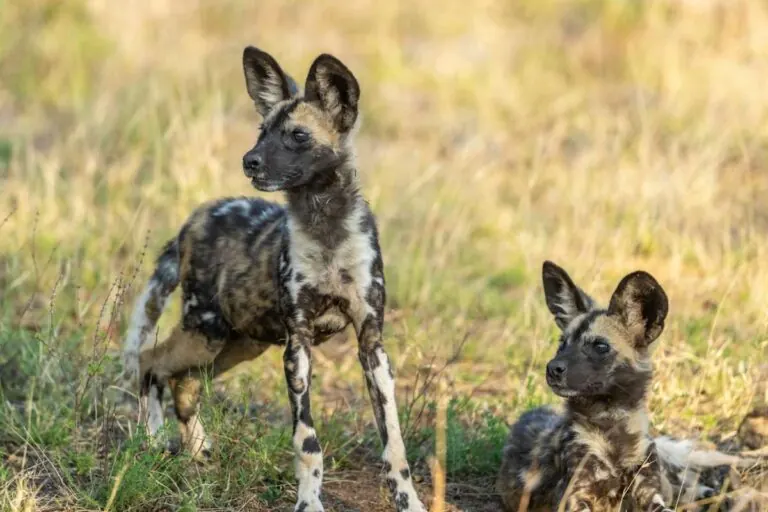
Ask most people to name Africa’s best hunter and they’ll say lion or cheetah. Ask a field biologist and you’ll often get a different answer: the mottled, big-eared canid that looks like someone spilled paint on a greyhound. Most African wild dog facts you’ll find online barely scratch the surface of what makes this animal worth knowing about.
The African wild dog is one of the continent’s most social, most misunderstood, and most threatened predators. Fewer than 7,000 remain, and roughly 700 breeding pairs are left across all of Africa.
What follows covers the biology, the pack behavior, the survival numbers, and the parts most articles get wrong. Several of the most repeated claims about the species turn out to be outdated once you check the field research.
An estimated 6,600 adults, including 1,400 mature individuals, live across 39 subpopulations, all under pressure from habitat fragmentation, human persecution, and disease outbreaks.
What exactly is an African wild dog?
It is not a feral domestic dog, and it is not a hyena. It is the sole surviving member of its own genus.
Lycaon pictus is the largest wild canine in Africa and the only living member of the genus Lycaon, set apart from Canis by teeth built for a hypercarnivorous diet and by the absence of dewclaws.
Your golden retriever is not a relative
Domestic dogs sit in the genus Canis, descended from the gray wolf. Wild dogs branched off millions of years ago and belong to a separate lineage entirely.
The practical result: the two cannot interbreed. Anyone selling a “wild dog hybrid” puppy is selling something else.
Why “painted wolf” is gaining ground
The Latin name translates roughly to painted wolf-like animal, and conservationists increasingly prefer painted dog or painted wolf over “wild dog.”
The reason is reputational. “Wild dog” sounds like vermin, and for most of the twentieth century these animals were shot on sight as pests. A name change is a small thing, but it shapes how farmers and tourists react to seeing one.
Body facts: built for the long chase
Four toes, not five
Every other canid on earth has a dewclaw. The African wild dog differs from every other member of the dog family in having only four toes on each foot.
The middle two toe pads are often partly fused as well. Both traits reduce weight at the end of the limb, which matters when you cover long distances daily.
Teeth designed to eat fast
Here is a detail almost no listicle mentions. Wild dogs have proportionately large premolars, the largest relative to body size of any carnivore except hyenas, and the heel of the lower carnassial carries a single blade-like cusp that boosts shearing ability.
That feature, called a trenchant heel, is shared with the Asian dhole and the South American bush dog. None of the three are closely related. All three evolved it independently because their niche demands eating prey fast, which makes it a textbook case of convergent evolution.
Speed of eating is a survival trait. A pack that lingers over a kill loses it to lions or spotted hyenas.
A coat that works like a fingerprint
No two painted dogs carry the same pattern of black, tan, white, and brown. Researchers use those unique coat patterns to identify individuals in the field.
The fur itself is unusual too: stiff bristle hairs with essentially no undercoat.
Ears you can spot from across the plain
Those oversized, rounded ears do double duty, shedding heat and catching sound. Hearing appears to matter more to wild dogs than smell during coordination on the move.
Habitat facts: where they actually live
The old textbook image of wild dogs sprinting across open grassland is now the exception rather than the rule.
Most of the remaining population occupies mixed woodland savannah, not the open grass plains of East Africa where the classic behavioral studies were done. They also turn up in semi-desert, scrub, and montane habitat.
Historically found across most of sub-Saharan Africa, they now persist in only about 8.5% of their former range. The species has vanished from 19 of the 34 countries it once occupied.
Today’s strongholds are northern Botswana, Zimbabwe, Tanzania, Mozambique, Zambia, Namibia, and South Africa, with a scattered presence in Kenya.
One pack needs a startling amount of land
In the Okavango Delta, packs average about 10.4 individuals and hold territories ranging from roughly 367 to 999 square kilometers. That’s a home range bigger than New York City for a group the size of a soccer team.
This is precisely why fragmentation hits them so hard. There simply aren’t many unbroken landscapes left that are big enough.
Hunting facts: about that famous 80% success rate
Nearly every article you’ll read claims painted dogs succeed in 80% of hunts. The number is repeated so often it has become received wisdom, but it is not a universal success rate across habitats.
The research is messier and more interesting than that.
Where the high figure comes from
The classic success rates were recorded on the short-grass plains of East Africa, where packs ran long, coordinated endurance pursuits after single animals. Some field studies in particular habitats and prey contexts recorded packs succeeding in well over half their hunts, and occasionally as many as nine in ten.
Those conditions describe a shrinking slice of where wild dogs actually live now.
What GPS collars revealed
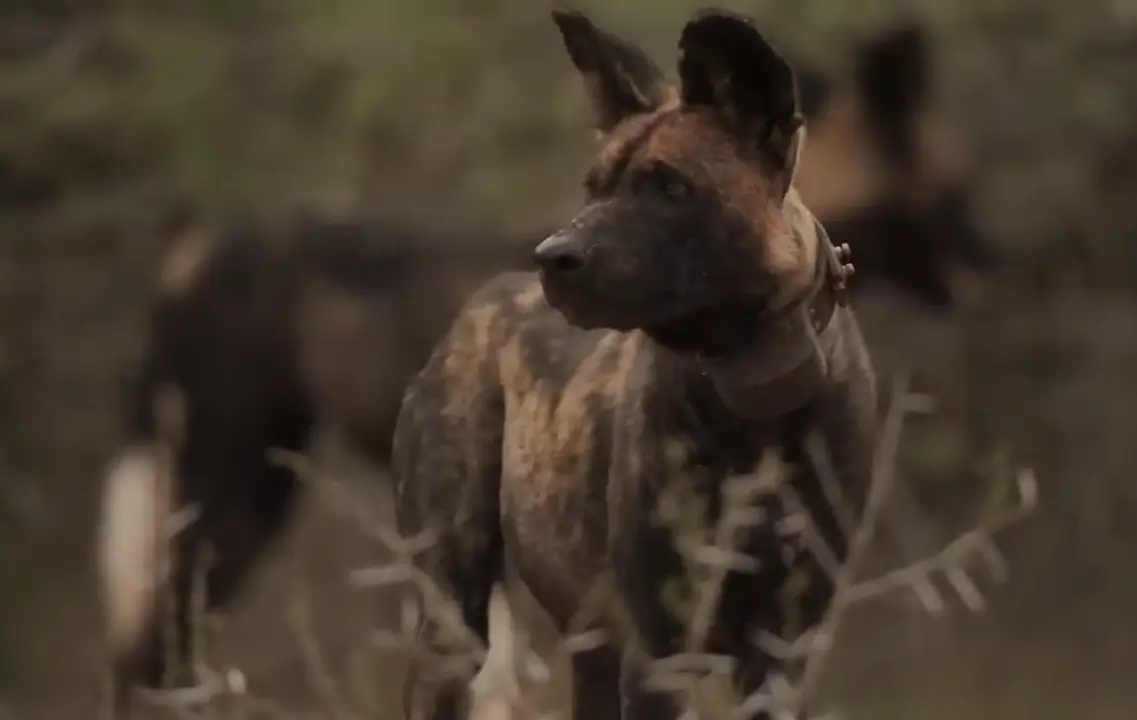
Researchers fitted high-resolution GPS and inertial collars to every adult in a pack of six in northern Botswana and recorded fine-scale movement. The dogs used repeated short-distance hunting attempts with an individual kill rate of just 15.5%, yet maintained a high group feeding rate because they shared prey. The team recorded no evidence of high-level cooperative chase strategies. For the full comparison of success rates, pack strategy, chase distance, and habitat effects, see our guide to African wild dog hunting.
A companion study logged 1,119 high-speed chases and used an energy balance model to show that returns from group hunting and shared feeding comfortably outweigh the cost of many short, mostly failed chases.
So the honest version is this: in woodland, individual chases usually fail, but enough dogs chasing enough prey at once means the pack eats well. The efficiency is real. It just comes from numbers and sharing, not from wolf-style tactical teamwork.
That distinction matters for conservation, because it explains why a pack that drops below roughly six adults tends to struggle.
When and what they hunt
Wild dogs are crepuscular, doing most of their hunting in short bursts around dawn and dusk. On hotter days they shift more activity into the night, though mainly on moonlit nights, and they rarely use this strategy while raising pups.
Medium antelope form the core of the diet: impala above all, plus kudu, springbok, duiker, reedbuck, and wildebeest calves. Warthog, hares, and the occasional bird fill the gaps. You can see the full prey list by region in our guide to what African wild dogs eat.
They rarely take livestock, despite the reputation that got them persecuted for a century.
Pack life: one of the most cooperative societies in nature
A wild dog pack is built around a dominant breeding pair, usually the only two animals that reproduce. Everyone else hunts, babysits, and feeds the pups.
Pups eat first
Adults let the youngest animals feed ahead of them at a carcass, and returning hunters regurgitate meat at the den. Reverse the hierarchy at dinner and you have the essence of what makes this species unusual.
They also feed the sick and injured
Pack members that are too old, ill, or hurt to hunt still get fed. In a species this dependent on group size, keeping a wounded adult alive is both compassionate-looking and strategically sound.
They vote by sneezing
This is the finding that made headlines, and it holds up. Before moving off, packs hold high-energy greeting ceremonies called social rallies. Not every rally results in the group actually leaving.
Researchers found that whether a rally succeeded was predicted by a minimum number of audible rapid nasal exhalations, or sneezes, during the rally. The team recorded 68 rallies across five packs in Botswana. The more sneezes, the more likely the pack got up and hunted.
When the dominant pair joined in, only a few sneezes were needed. Without them, roughly ten were required. Dominant participation makes a rally more likely to succeed but isn’t required. The will of the group can override the leaders’ preference when enough subordinates agree.
Not a perfect democracy. Some votes weigh more than others. Still remarkable for a carnivore.
They call to each other across miles
The vocal repertoire runs from bird-like twitters to a deep, mournful contact call. The “hoo” is the only known long-distance contact call, given most often when dogs get separated during a hunt.
A separated dog drops its muzzle toward the ground and produces a sound audible several kilometers away.
Pup and reproduction facts
The alpha female produces the largest litters of any canid: commonly 6 to 16 pups, sometimes more, after a gestation of about 69 to 73 days.
Dens are usually borrowed. Abandoned aardvark, warthog, or porcupine burrows do the job. Pups stay underground for roughly three months while the pack commutes daily between hunting grounds and the den.
That commute is the vulnerable period. Adults burn enormous energy carrying food back, and the pack’s range collapses to whatever it can cover and still return.
Which sex leaves home
Many articles say males stay and females leave. The truth is closer to that than the reverse, and it’s genuinely unusual. Uniquely among social carnivores, it is largely the females rather than the males that disperse from their birth pack once mature.
Dispersing groups of siblings travel long distances to find unrelated dogs and form new packs, which is how the species spreads genes across fragmented landscapes.
Predators, rivals, and competition
Adult wild dogs have few true predators, but lions kill them regularly, including pups at dens. Packs actively avoid areas lions use heavily.
Spotted hyenas are the other problem. They rarely kill adult dogs but frequently steal kills, which forces the pack to hunt again and burn more energy.
Crocodiles take dogs at water crossings. In some landscapes, the leading cause of death is neither predator nor competitor. It’s people.
Endangered facts: why the numbers are so low
Painted dogs were never abundant, but the collapse has been severe. Understanding the causes explains why they remain one of Africa’s most vulnerable large carnivores.
Habitat fragmentation. With home ranges in the hundreds of square kilometers, packs constantly cross out of protected areas into farmland and roads.
Snares. Wire snares set for bushmeat catch wild dogs indiscriminately. A single snaring incident can be catastrophic for an entire pack, given how much their survival depends on group size and teamwork.
Roads. Vehicle collisions are a leading cause of death in several populations.
Disease. Contact with unvaccinated domestic dogs exposes packs to rabies and canine distemper, which can move through a pack rapidly with high mortality. Vaccination programs in surrounding communities are a core part of the conservation response.
Small, isolated populations. The species has been listed as Endangered on the IUCN Red List since 1990, and the largest single subpopulation probably holds fewer than 250 individuals.
The threat competitors leave out: heat
This is the most important recent development in wild dog science, and none of the popular fact pages mention it.
Three concurrent studies by ZSL, the Botswana Predator Conservation Trust, and the African Wildlife Conservation Fund monitored 73 packs across Kenya, Botswana, and Zimbabwe over a combined 42 years. At the Botswana site, average daily maximum temperature during the pup-rearing period rose by roughly 1°C between the first and second twelve years of monitoring. Over the same period, the average number of pups surviving per pack per year fell from five to three.
Lead author Professor Rosie Woodroffe of ZSL noted that people picture polar bears when they think of climate and wildlife, yet species already adapted to tropical heat are being affected too. A later study found packs are now giving birth progressively later each year, tracking a shrinking cool season. Related work also links high temperatures to increased adult mortality.
For a species that needs high pup recruitment to offset losses, a drop from five surviving pups to three is a serious problem.
Reasons for optimism
The picture isn’t uniformly grim, and the recovery stories are genuinely impressive.
Gorongosa, Mozambique. Wild dogs were wiped out of the park during the civil war. A transboundary translocation established founder packs, which formed additional packs naturally, produced and successfully raised pups, and grew the population significantly, with all mortality during the study period coming from natural causes. From 29 dogs introduced as four packs, the population has since grown past 200 individuals.
The wider metapopulation effort. Across South Africa, Mozambique, Malawi, and Zambia, more than 1.5 million hectares have been secured or restored for wild dogs, and over 350 individuals in 35 packs now occupy landscapes where the species had been absent.
Malawi. In July 2021, 14 wild dogs were translocated from South Africa and Mozambique to Liwonde National Park and Majete Wildlife Reserve, returning the species to the country.
Chemical fencing. Researchers are working on artificial scent boundaries to keep packs inside safe areas without physical fences. Botswana Predator Conservation’s BioBoundary project recorded wild dogs responding behaviorally to lab-produced components of their own territorial scent marks, overmarking synthetic scent exactly as they would a natural one.
African wild dog facts for kids
Short version for younger readers and school projects:
- They have four toes on each foot. Every other kind of dog has five.
- No two have the same coat pattern, like human fingerprints.
- The puppies get to eat first, before the adults.
- The whole pack helps raise the babies, not just the mom and dad.
- They sneeze to vote on whether it’s time to go hunting.
- They make a soft “hoo” sound to find each other when they get lost.
- Mothers can have more than a dozen puppies at once.
- They can run about as fast as a car on a neighborhood street.
- Their ears are huge and help them stay cool.
- There are fewer than 7,000 left, so scientists are working hard to protect them.
Common myths and mistakes
“They’re feral dogs gone wild.” No. Different genus, separate lineage, cannot interbreed with domestic dogs.
“They’re related to hyenas.” Also no. Hyenas aren’t canids at all. Their closest relatives are mongooses and civets.
“They succeed in 80% of hunts.” Habitat-dependent, and the woodland data tell a different story. Individual chase success can be under 20%.
“They kill livestock constantly.” Studies repeatedly show livestock predation by wild dogs is uncommon, even where cattle are abundant. The perception drives persecution that the evidence doesn’t support.
“Packs are ruled by an aggressive alpha.” Dominance exists, but serious within-pack fighting is rare compared with other large social carnivores, and group consensus can override the leaders.
Where to see them in the wild
Sightings are never guaranteed. These are wide-ranging animals at low density, but some places offer far better odds.
- Botswana: Okavango Delta, Moremi, Linyanti
- Zimbabwe: Mana Pools, Hwange
- Tanzania: Nyerere (formerly Selous), Ruaha
- South Africa: Kruger, Madikwe, northern KwaZulu-Natal reserves
- Mozambique: Gorongosa
- Zambia: South Luangwa, Kafue
Denning season is the sweet spot. Packs stay anchored to one location for about three months, which makes them far easier to find than during their nomadic phase. Ask any operator when local denning typically occurs before booking.
Frequently asked questions
Are African wild dogs endangered?
Yes. The IUCN has listed them as Endangered since 1990, and the population continues to fall. Roughly 6,600 adults survive across 39 fragmented subpopulations, and the largest of those probably holds fewer than 250 animals. Snares, road collisions, disease from domestic dogs, and shrinking habitat all drive the decline, and no single fix addresses them.
How many African wild dogs are left in the world?
Around 6,600 adults remain, of which roughly 1,400 count as mature breeding individuals under IUCN criteria. That translates to fewer than 700 packs continent-wide. Numbers fluctuate sharply because a single disease outbreak can erase a whole pack, so any figure you read is a snapshot rather than a stable count.
Can African wild dogs be kept as pets?
No. They are wild pack animals with no history of domestication, and private ownership is illegal in almost every country. A single pack needs a territory of several hundred square kilometers and a diet of fresh meat. Even zoos find them demanding, since isolated individuals struggle without a functioning social group around them.
Are African wild dogs dangerous to humans?
Not meaningfully. Documented attacks on people are extremely rare, and there is no pattern of wild dogs treating humans as prey. They usually move away from vehicles and people on foot. The real danger runs the other way: humans kill far more wild dogs than the reverse, through snares, guns, and traffic. Our guide to whether African wild dogs are dangerous covers the one zoo tragedy and how to stay safe on safari.
What is the difference between an African wild dog and a hyena?
They belong to different families. Wild dogs are canids with four toes, long legs, rounded ears, and blotched coats. Hyenas sit in Hyaenidae, are more closely related to mongooses and civets, and carry sloping backs with far heavier bone-crushing jaws. Spotted hyenas also regularly steal kills from wild dog packs.
Why are African wild dogs called painted dogs?
The scientific name Lycaon pictus translates roughly as painted wolf-like animal, a reference to the blotched coat that differs on every individual. Conservationists increasingly prefer painted dog or painted wolf because “wild dog” implies vermin, and that association helped justify decades of shooting, poisoning, and government-sanctioned culling across southern Africa.
How fast can an African wild dog run?
Sprint speeds reach roughly 40 to 44 mph, comparable to a greyhound, though stamina matters more than top speed. GPS collar data from Botswana shows most chases are short and fast rather than the marathon pursuits older accounts describe. Packs still cover long distances daily while searching for prey and safe denning sites.
Do African wild dogs bark?
Not the way domestic dogs do. Their range covers bird-like twitters during greetings, whines and whimpers between pack members, growls, and the long-range “hoo” contact call used when someone gets separated. That hoo carries several kilometers and is often the only clue a pack is nearby in thick woodland.
The bottom line
Strip away the safari-brochure gloss and what you find is a predator that runs on cooperation. Pups eat first, injured adults get fed, decisions get taken by something close to a vote, and hunting success comes from many dogs trying and sharing rather than from any individual’s brilliance.
That same dependence on group size is exactly what makes them fragile. Lose a few adults to a snare or an outbreak, and the pack can fall below the threshold where the whole system works. We cover the species in depth across this site, from pack behavior to the conservation projects working to protect them.
The most useful African wild dog facts are the ones that connect the biology to the conservation problem. Gorongosa proved recovery is possible when there’s enough space, enough protection, and enough political will. The question is whether enough of those landscapes remain.